The Making of Stag Hunt
October 29, 2026
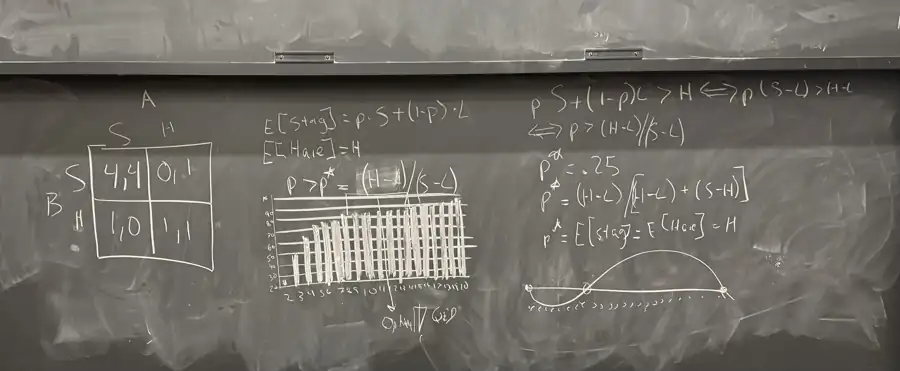
Stag Hunt started online. I coded the first version in six hours. A week later, I went to a chalkboard to check the math with my own monkey eyes. This is that board.
The game is old. Rousseau told it first: two hunters can chase a stag together, or each can grab a hare alone. The stag feeds everyone well, but only if both commit. The hare is small, but it’s guaranteed. Neither hunter is greedy and neither is a cheat. The only question is whether each one trusts the other enough to go for the big prize.
Dinner at Dewick
Good startup ideas don’t come from sitting down to think up startup ideas. They just show up, like a revelation.
Mine showed up in the Dewick dining hall. I was eating a slop bowl of rice, lamb, beef, and a little stew, made by the workers who work so hard to feed us well every day, and reading Naval Ravikant alongside a lot of game theory. I was turning the Stag Hunt over in my head, and it hit me: I could make this a real, playable game, with early-stage investing as the hunt.
I already knew what building a company costs. Squibber taught me everything I needed to learn about startups, including that they take decades to build. Time is finite, so you have to pick the game you want to play. I wanted an arena growing exponentially faster than GDP, and one that’s ethical, because ethics runs deep in my value system.
After dinner I called my boy Seth, who co-founded Squibber with me. “Yo, I have a new idea. I need help.” We booted up Claude, Seth helped hook it up to Cloudflare, and I bought staghunts.com because the plain name was taken. The whole setup cost less than $25, and I coded the site in six hours.
Checking it with monkey eyes
I used Claude to work out the best-case version of the game with real math. About a week after the site went up, I drew it on a chalkboard to check it with my own monkey eyes and monkey brain.
The grid is the whole game. If we both hunt stag, we each get 4. If I hunt stag and you go for hare, I get nothing and you get 1. Hare always pays 1, no matter what anyone else does. So going for the stag pays off whenever the odds that the others commit, call it p, are good enough:
p·S + (1−p)·L > H
⇔ p > (H−L)/(S−L) = 1/4 = 0.25
That’s the 0.25 on the board. You don’t need everyone to trust you, only one in four. Above that line, hunting stag is the rational move. Below it, everyone grabs hares. The curve at the bottom right shows both outcomes are stable: the whole group hunts stag or the whole group settles for hares, and 25% is the tipping point between them.
What made me stare at that board was the repetition. Play this once and it’s a nice result. Play it over and over for decades, with the same trusted players, and the returns compound into something tremendous. A few billion in the short term, maybe. Trillions in the long term, if it’s played right.
Designing the hunt
The best way to play is to keep it scarce. I studied quantitative economics for three years before switching to the econ BA, and the first thing economics teaches you is that everything runs on scarcity. My first plan was twelve players. Twelve would have inflated the group and made it harder to keep honest. So I cut N to six: a scarcer group I can actually steward, played by better players.
I only want to see moonshots. Not $100 million markets. Billions to trillions, because we’re only on Earth once. Go big or go home, as they say in Texas.
So the room is built to see the best deals in the world:
- An MIT professor and an HBS professor who see a huge number of deals
- A couple of AI researchers and specialists
- Two operating founders already in multitrillion-dollar markets that are growing exponentially
- Me, as the connector, alongside the professors
Each of these people already sees great deals inside their own world. Stag Hunt makes them cooperate across those worlds. At the end of the day it’s a cooperation game, played over and over.
It also has to grow slowly. One cohort first, then the next, each chosen carefully. A system that grows too fast collapses on itself, and if the top of the funnel doesn’t work, the bottom never will.
Play or don’t
What’s beautiful about building now is that I can use Claude to work through all of it mathematically. The math says the game works if people play.
The best part is that it respects human agency. Nobody is forced to hunt. If someone doesn’t play, it only hurts them, because I’ll replace them with someone who will, and the game gets stronger. You can catch a hare on your own. Together, you can catch a stag.
I don’t know where this project is going. I do know it’s something valuable.